
A groundbreaking. A ribbon cutting. A grand opening. A topping-out ceremony. A donor reception. A corporate anniversary. An employee town hall. A dedication. These are the moments organizations work years to reach, and how they are executed reflects directly on the brand, the leadership, and the relationships that made them possible.
At LMC Agency, strategic communications and event planning go hand in hand. We have supported clients through milestone moments of all sizes, and we have learned that the details matter as much as the vision. This checklist is your starting point for making sure your next event is not just well-attended, but truly unforgettable.
Start with the Big Picture
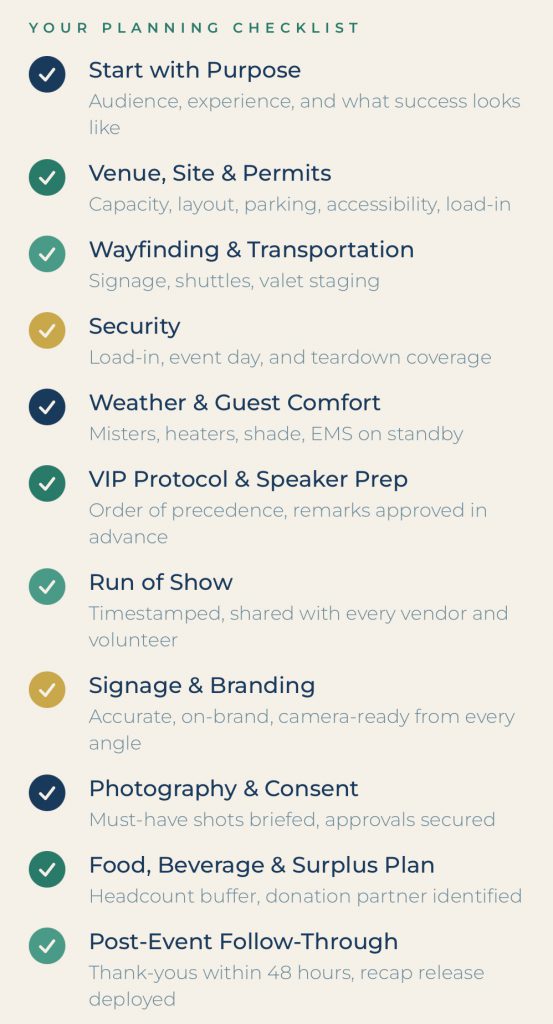
Before a single vendor is booked or a venue is confirmed, get clear on purpose. Who is your primary audience? What is the intended experience? What does success look like? Every decision that follows should serve those answers. A donor-funded dedication carries a different tone than a corporate town hall, and a groundbreaking in an open field presents different logistics than a grand opening in a finished space. Know what you are planning before you plan it.
Venue, Site, and Permits
Confirm capacity, layout, parking, and accessibility for all guests, including those with mobility considerations. Identify load-in and load-out windows for vendors, rentals, and signage. Secure any required permits well in advance, especially for outdoor events or those held on public or donor-funded property. If any element of your event involves tenting, open flames, generators, or amplified sound, check local ordinances early. Surprises at the permit stage are never welcome.
Parking, Transportation, and Wayfinding
Do not assume guests will figure out parking on their own. If your venue has limited parking, plan for shuttle service from a designated offsite lot and communicate pickup and drop-off logistics clearly in your pre-event communications. On site, invest in clear, professional directional signage so guests never have to guess. Signs should indicate parking areas, valet drop-off if applicable, the main entrance, registration or check-in, restrooms, and any overflow areas. Poor wayfinding creates frustration before your guest ever walks through the door, and that first impression matters. If valet service is part of the experience, confirm staffing ratios, tip protocols, and vehicle staging well in advance.
Security
Do not wait until event day to think about security. If your event involves significant technology setup, audio-visual equipment, staging, branded displays, or high-value rentals, you may need security coverage beginning the night before load-in. Consider the full timeline: the day or more in advance when equipment and materials begin arriving on site, the day of the event itself, and the teardown period that evening when vendors are still on property and equipment is being packed and loaded out. High-profile events, those held in open or public spaces, and events with notable speakers or donors in attendance may also warrant a visible security presence throughout the program. Coordinate with your venue on their existing protocols and determine early whether supplemental contracted security is needed. Do not assume it is covered.
Weather Comfort and Guest Experience
In Texas, weather is not a minor inconvenience — it is a planning variable that deserves its own line item in your budget and your checklist. Do not leave it to chance in either direction.
For warm and hot weather events, particularly those held outdoors or in spaces without adequate climate control, consider handheld fans available at guest entry points, electric standing fans powered by a generator if venue power is not accessible, and cooling misters strategically placed in high-traffic and seating areas. Shade structures, tenting, and timing your program to avoid peak afternoon heat are also worth evaluating. Have cold water readily available and visible throughout the event footprint.
When heat conditions are extreme, having emergency medical services or first responders on site or on standby is not an overreaction — it is responsible event management. This is especially important when your guest list includes elderly attendees, young children, or individuals with health considerations, or when the event involves prolonged outdoor exposure with limited shade. Coordinate with local EMS in advance, confirm response protocols, and make sure at least one designated team member knows exactly who to call if something happens.
For cold weather and winter events held outdoors or in open structures, portable propane or electric heaters should be deployed thoughtfully across the space, with particular attention to seating areas, the stage or ceremony area, and any lines where guests may be waiting. Confirm fuel supply and safety clearances in advance. If your event is a groundbreaking, a topping-out ceremony, or a dedication held at a construction site or open-air venue, cold weather comfort for both guests and your program participants is essential.
In any season, monitor the forecast closely in the days leading up to the event and have a clear decision tree for what changes if conditions shift. Your guests will remember how they felt physically just as much as what they heard from the podium.
First Aid and Emergency Preparedness
For larger events, particularly those with a broad guest mix that includes elderly attendees, young children, or individuals with medical needs, a dedicated first aid tent or station is a smart and responsible addition to your event footprint. Stock it with basic supplies including bandages, ice packs, pain relievers, and water, and make sure it is clearly marked and easy to locate from the main event area. Designate a trained staff member or volunteer to manage the station throughout the event. If you have EMS on standby, coordinate with them on the location of the first aid tent so they can respond quickly if a situation escalates. For very large crowds, consider working with your local fire department or a private medical services provider to staff the tent professionally. Guests who feel safe and cared for are guests who stay engaged, and organizations that plan for the unexpected protect both their attendees and their reputation.
Food and Beverage
Align quantities with your confirmed headcount and build in a reasonable buffer. Plan in advance for what happens to surplus food. Strong options include donating to a local shelter or food bank, many of which accommodate event pickups with advance coordination; offering take-home containers for guests; sharing with employees at a nearby worksite who were not able to attend; or partnering with a local school or nonprofit organization. Designating one person to manage food logistics on event day removes ambiguity and last-minute scrambling.
Program and Run of Show
Build a detailed run of show with time stamps for every element, from guest arrival through the final remarks. Share it with every vendor, volunteer, and team member in advance. Identify your emcee early and brief them thoroughly on the agenda, the key guests in the room, and any pronunciation sensitivities for names, places, or organizational titles. Your emcee sets the tone for the entire program — choose that person with intention.
VIP Management and Protocol
If your event includes elected officials, major donors, board members, executives, or other high-profile guests, protocol planning is not optional — it is essential. The order in which VIPs are introduced, seated, and recognized on the program is not arbitrary. It communicates respect, hierarchy, and organizational awareness, and getting it wrong can create lasting friction with people whose relationships matter to your organization.
Start by identifying every VIP on your guest list early and researching the appropriate order of precedence. Elected officials, for example, follow a specific protocol based on level of office — federal before state, state before local — and their offices will often have staff who can advise you. Build your speaker order and seating chart with that protocol in mind.
Communicate with each VIP’s office or representative well in advance. Many elected officials and senior executives will arrive with their own staff, a communications director, a scheduler, or in some cases personal security. Know who is coming with them, plan for their arrival logistics, and make sure your team knows how to receive them. Designate a specific point of contact on your staff whose sole responsibility is greeting and managing VIPs from the moment they arrive until they depart.
Provide remarks, talking points, or scripts to VIP speakers well ahead of the event — not the day before, but with enough lead time for their staff to review, edit, and approve. Build that review window into your communications timeline and follow up proactively. Do not assume their office received what you sent. Confirm it.
Finally, brief your emcee thoroughly on how to introduce each VIP, including correct titles, pronunciations, and any honorifics. A mispronounced name or incorrect title for a sitting official is the kind of detail that lingers.
Speakers and Staging
Think through the full physical experience for every person on your program. If multiple speakers are sharing a stage or podium, consider their heights and whether the microphone and podium can be adjusted between speakers. Think carefully about seating on stage. Bar-height stools can be difficult and uncomfortable, particularly for guests wearing dresses or skirts, and they can present real challenges for speakers who are shorter in stature. Standard chairs or appropriately scaled seating are often the safer and more dignified choice. Make sure every speaker knows in advance where they will be seated, when they will be called forward, and exactly what is expected of them. No one should be surprised once the program begins.
Commemorative Gifts for VIPs and Speakers
Your VIPs and speakers have given their time, their name, and their platform to your event. Acknowledging that with a thoughtful commemorative gift is a meaningful gesture that reinforces the relationship long after the event concludes. The gift does not need to be elaborate, but it should be intentional — something tied to the occasion, the organization, or the milestone being celebrated. A framed rendering of a new facility, a custom piece recognizing their participation, a locally sourced item, or a branded keepsake tied to the event theme are all strong options. Present gifts personally and graciously, and whenever possible, have a senior leader or the host organization make the presentation. It is a small moment that leaves a lasting impression.
Invocation or Blessing
If your program includes an invocation, select the right person with care and brief them on tone, length, and audience. A well-delivered, welcoming invocation sets a meaningful tone for the event. The person you select should understand the composition of the room and be prepared to deliver a message that is inclusive and appropriate for the full audience in attendance.
Entertainment and Community Engagement
Consider whether your event creates a natural opportunity to involve local schools, youth organizations, or community groups. A choir, a student ensemble, or youth organization participation can add warmth and deepen community connection. These partnerships also tend to generate goodwill and media interest that extends well beyond the event itself.
Printed Materials, Programs, and Event Displays
Do not leave your guests guessing about what is happening or who is speaking. A well-designed program or agenda gives attendees context, helps them follow along, and serves as a keepsake for milestone events. Depending on your audience and budget, you have several solid options to consider.
Printed programs or invitations remain a strong choice for formal events, dedications, and donor-facing occasions where a tangible, branded piece adds to the experience. For more casual or environmentally conscious events, a QR code displayed at registration or printed on a simple card can direct guests to a digital version of the program on their phones. For larger gatherings or events where visibility matters, displaying the agenda on a large screen that the full audience can see keeps everyone oriented and on the same page throughout the program. If your venue does not have built-in screens, plan ahead — bringing additional monitors or renting display equipment may be necessary and is well worth the investment. Whatever format you choose, make sure the agenda is accurate, proofread, and reflects the correct names, titles, and spelling for every person listed. A program is often the one tangible item guests take home, and the details on that page reflect directly on the organization.
Signage and Branding
Confirm that all signage, backdrops, banners, and branded materials are accurate, on brand, and positioned for both in-room visibility and photography. If a podium or step-and-repeat backdrop will appear in photos, make sure it is camera-ready from every anticipated angle. Branded materials left crooked, poorly lit, or partially obscured in official event photography are a missed opportunity.
Photography, Videography, and Consent
Designate a photographer and, if appropriate, a videographer. Brief them on the must-have shots: the ribbon cutting, the shovel turn, the topping-out moment, the keynote speaker at the podium, the handshake, the crowd. If media are invited, prepare a press kit and designate a media point of contact for the day. Capture social-ready content in real time for immediate post-event use.
Before your photographer or videographer begins capturing images, however, ask a critical question: is everyone in that frame cleared to be photographed? This is not a formality — it is a responsibility. Some guests may have privacy concerns, safety considerations, or personal circumstances that make photography problematic. Elected officials and executives may have communications staff who want to approve images before they are used publicly. Certain events involving sensitive populations, donor relationships, or legal matters may require signed consent or release forms before any images are shared externally.
If your event includes children, confirm in advance what permissions are required. If it is held at a facility with specific photography policies, know them before your photographer arrives. If media are present, be clear about who has agreed to be interviewed or photographed and who has not, and make sure your media point of contact is empowered to enforce those boundaries.
Build photography approvals and consent into your pre-event workflow, not your post-event scramble. Knowing before the shutter clicks who can be photographed, how images can be used, and who has final approval over what gets published will save you from uncomfortable conversations and potential missteps after the fact.
Overnight Accommodations for Staff and Vendors
Depending on the location of your event and where your team members live, overnight accommodations may not be a luxury — they may be a necessity. If your staff or key vendors are facing a late teardown followed by an early morning the next day, expecting them to drive long distances in between is neither safe nor practical. Identify early which team members may need rooms, negotiate a room block at a nearby hotel if multiple people are involved, and confirm checkout and parking logistics so nothing adds friction on event morning. This same consideration extends to out-of-town speakers, performers, or special guests who are part of your program. Taking care of your people the night before means they show up rested, focused, and ready to execute.
Communications Timeline
Develop a pre-event communications plan that includes save the dates, invitations, reminders, and day-of logistics for attendees. Prepare remarks, talking points, and any ceremonial scripts well in advance and allow time for speaker review and approval. Have post-event communications ready to deploy — including thank-you notes, a recap release, and social content — before the event concludes.
What to Wear: Dress for the Work, Not Just the Moment
Here is something they do not teach in communications school but every seasoned PR professional learns the hard way: pack two outfits.
Every public relations person alive has hung a banner, strung lights, run cable, set up chairs, passed out programs, and worked a teardown at the end of a long event day. Setup and teardown are physical work, and trying to do that work in your event-day outfit and dress shoes is a lesson you only need to learn once. Bring a comfortable, professional outfit and a pair of tennis shoes for load-in and setup. Change into your event attire before guests arrive. When the last guest leaves and it is time to break everything down, change back. Your feet, your back, and your outfit will all thank you. The best event teams show up ready to work and ready to shine — and they know the difference between the two.
Staffing and Volunteers
Create a clear staffing plan with defined roles and a single point of contact for each area of responsibility. Every team member and volunteer should arrive knowing the run of show, their assignment, the dress code, and who to contact if something goes sideways. Assume nothing. Brief everyone.
Post-Event Follow-Through
Send personalized thank-you notes to speakers, sponsors, donors, and key partners within 48 hours. Compile media coverage, social engagement, and attendance data. Document what worked, what to refine, and what to carry forward. The best events are also learning opportunities for the next one.
Your Moment Deserves to Be Done Right
Milestone events deserve to be executed with the same care and intention that went into achieving them. The details that seem small in the planning stage — the seating on stage, the directional signage, the first aid tent, the overnight rooms for your team — are the details your guests and your leadership will notice when they are missing.
At LMC Agency, we partner with organizations to make sure every element reflects the significance of the moment. Because when it is your time to shine, everything should be ready.
Ready to plan your next milestone event? Contact LMC Agency to get started.
P.S. Do not forget your tennis shoes.